
Aristolochia baetica
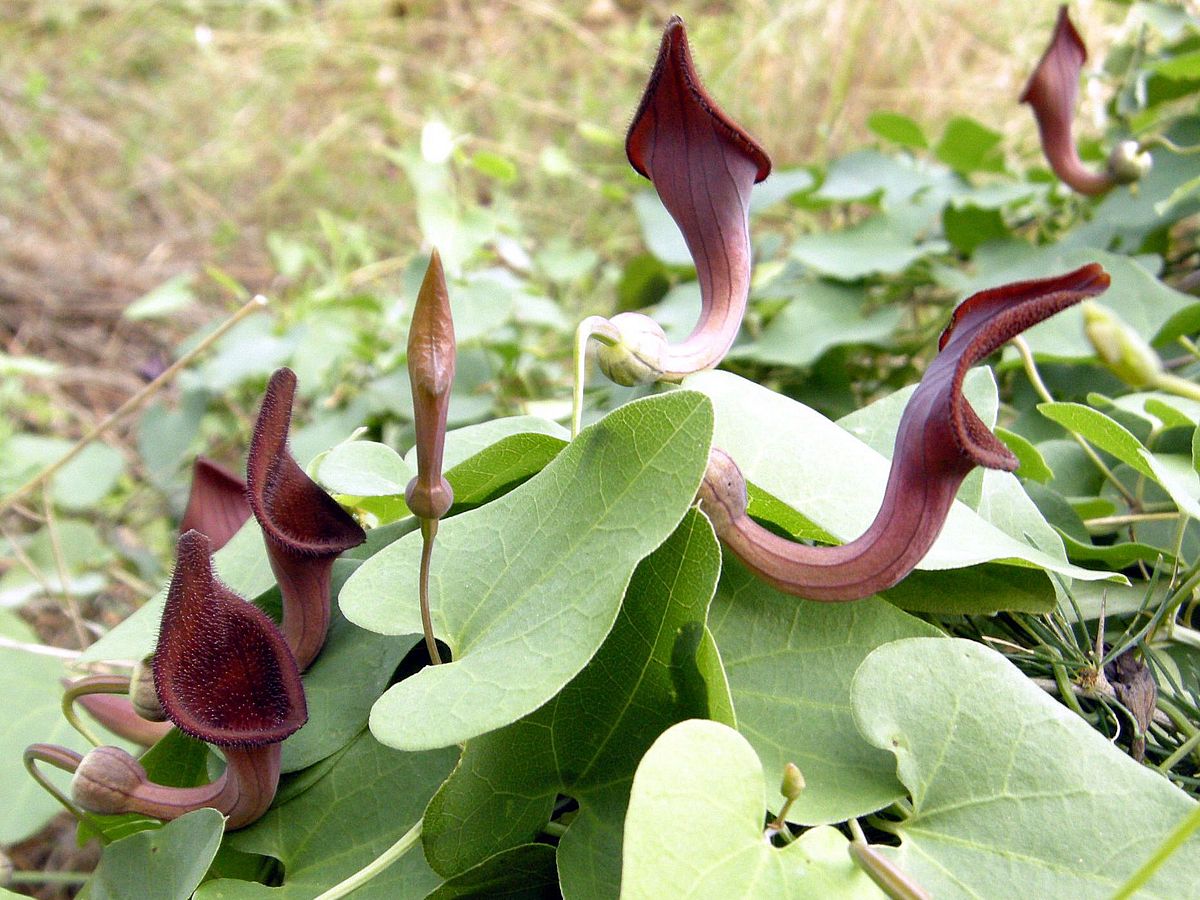
Scientific name: Aristolochia baetica L.
Family: Aristolochiaceae
Common name: Andalusian Dutchman's Pipe, Birthwort, Pipe Vine
We’re talking about a plant native to our region, since Aristolochia is native to Spain and Portugal—hence the species name baetica, derived from *Bética*. The genus name comes from Greek: aristos means “excellent,” and lochia refers to childbirth, because some of these species were historically used in obstetrics to induce labor.
It is a shrub with slender, climbing stems and heart-shaped evergreen leaves. The flowers are very distinctive, a very dark purple-brown color, with an “S”-shaped curved tube that is swollen at the base, making them resemble small oil lamps. They have six fused stamens. They grow singly and can measure between 2 and 8 cm in length. Aristolochia is found in scrublands and understory throughout the southern Iberian Peninsula, the Levante region, and northern Morocco. It is pollinated by insects attracted by its distinctive aroma. The male and female parts of the flower never mature at the same time, thus preventing self-fertilization.
The active compounds it contains—especially in the root—have led to its use as a remedy for fever and as an emmenagogue, meaning it induces menstruation. In La Concepción, it can be found along the Ruta de los Miradores.